
Whimsy Maxxing: Why Adding More Play to Everyday Life May Be Good for You
Guest Blog by Abby Holt

Image from Pexels
Whimsy maxxing is the deliberate practice of adding more playfulness, imagination, novelty, and small moments of delight to ordinary life. Think wearing absurdly cheerful socks to work, eating lunch picnic-style on the living-room floor, taking the scenic route just because the trees look good, or turning a routine coffee into a tiny ceremony. The phrase itself is new, but the psychology underneath it is not. Whimsy maxxing simply means making room for experiences that feel interesting, pleasurable, surprising, creative, or wonderfully unnecessary.
The Short Version
Whimsy maxxing means choosing small doses of delight instead of treating every waking minute as an optimization problem. It may help interrupt monotonous stress patterns, create moments of positive emotion, and encourage the kind of playful reframing associated with more flexible coping. You do not need a hobby room, a vacation, or an elaborate morning routine to practice it; the entire point is that ordinary moments can become slightly stranger, prettier, funnier, or more absorbing.
What Counts as Whimsy?
There is no official rulebook, which is fortunate because an official rulebook would rather defeat the purpose. Whimsy might look like:
● Giving household objects unnecessarily dramatic names.
● Buying flowers because they resemble tiny fireworks.
● Taking photographs of pets or oddly shaped clouds.
● Making toast shaped like stars.
● Dressing according to a made-up theme for the day.
● Reading somewhere unusual, such as beneath a tree or inside a blanket fort.
● Drawing badly on purpose.
● Leaving ridiculous notes for someone you live with.
● Choosing a walking route based entirely on which street has the most interesting gardens.
The common ingredient is not aesthetics. It is permission to play without needing the activity to become productive.
What Happens When Life Gets a Little More Playful?
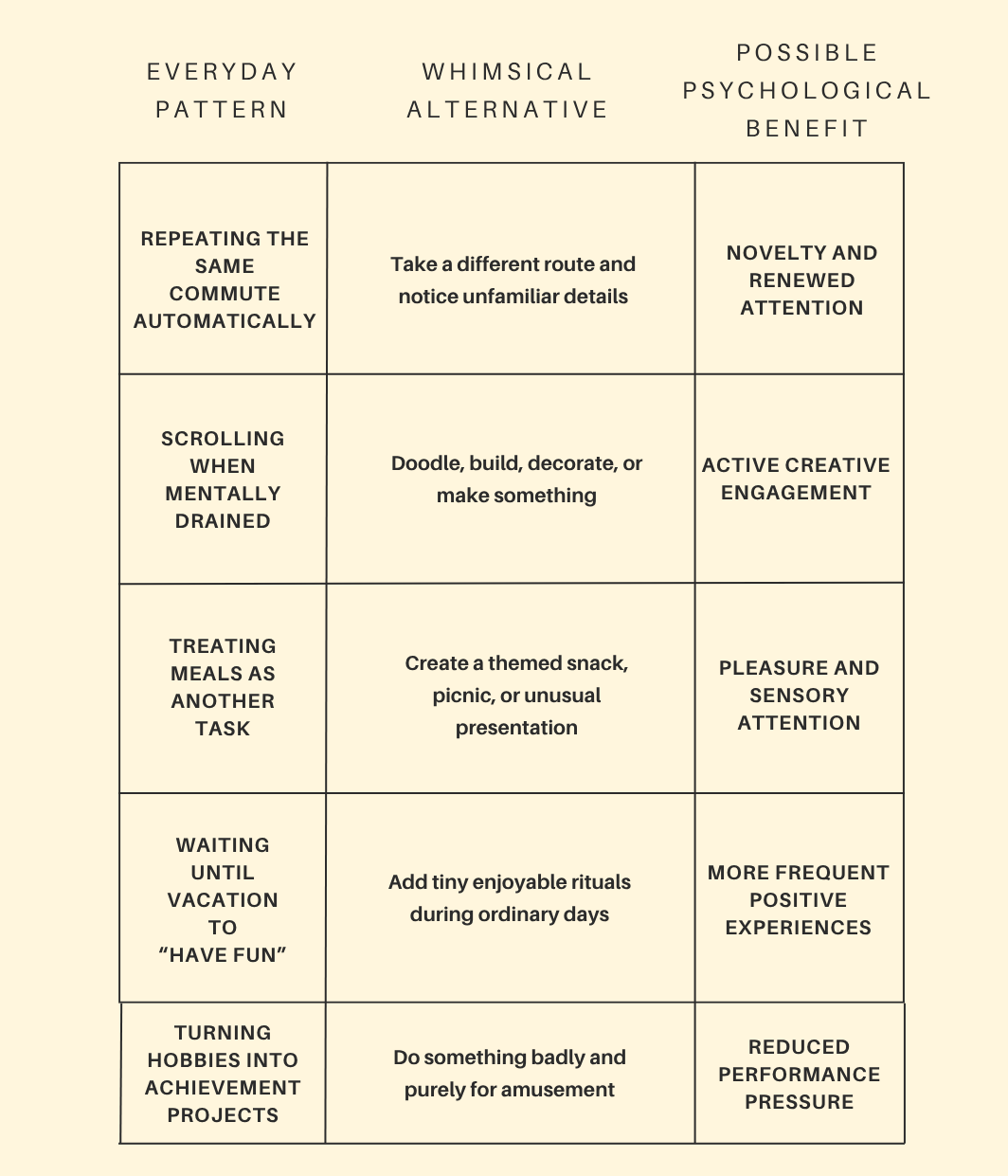
The goal is not to manufacture happiness on command. It is to make daily life contain more opportunities for curiosity.
Imagination Can Happen on a Screen, Too
Digital creativity can provide another playground when it is approached as experimentation rather than productivity. Someone might imagine themselves as a character from a surreal story, explore improbable costumes, or turn a loose visual idea into something tangible simply to see what happens next. The Adobe Firefly AI portrait generator can turn either a reference photo or a text description into digital portraits, with controls for elements such as lighting, camera angle, color, tone, and artistic effects. Used playfully, tools like this can turn “What if?” into a visual experiment — a particularly modern form of imaginative tinkering.
Why Reward Matters
Dopamine is frequently described online as a pleasure chemical, but neuroscience paints a more nuanced picture. Dopamine systems participate in motivation, reinforcement learning, reward prediction, and decisions about which rewarding experiences are worth pursuing.
Play itself is strongly connected with reward-related neural systems in animal research, and research on human behavior also shows dopamine activity during rewarding tasks such as video-game play. That makes it reasonable to connect playful activity with reward processes, but not to promise that every whimsical activity delivers a predictable “dopamine boost.”
The practical takeaway is simpler: the brain notices experiences that are novel, rewarding, interesting, and worth repeating. A life containing more of those experiences may feel less mechanically repetitive.
A Useful Place to Go When Stress Is Bigger Than Whimsy
Whimsy works best as an addition to healthy coping, not as a substitute for it. The National Institute of Mental Health’s guide to caring for your mental health offers practical, evidence-informed information on stress management, sleep, exercise, relaxing activities, social connection, and recognizing when professional support may be appropriate.
It is especially useful because it treats self-care realistically: different strategies work for different people, and experimentation is normal. The guide also distinguishes everyday self-care from situations where persistent or severe symptoms deserve professional attention. That boundary matters. A miniature disco ball may brighten Tuesday afternoon; it should not be expected to carry the weight of untreated depression, anxiety, or severe burnout.
Frequently Asked Questions
Is whimsy maxxing a real psychological therapy?
No. “Whimsy maxxing” is a cultural term, not a recognized therapy or clinical diagnosis. However, its underlying ingredients — playfulness, enjoyable activities, positive emotion, creativity, social connection, and curiosity — overlap with areas that psychologists study.
Do adults really benefit from playing?
Adult playfulness can function as a psychological resource and is associated with differences in stress perception and coping. Play does not need to resemble children’s games; humor, creative experimentation, spontaneity, hobbies, imagination, and playful social interaction can all qualify.
Can whimsy maxxing cure burnout?
No. Burnout can involve workload, lack of control, workplace culture, exhaustion, and other problems that require changes larger than individual self-care. Whimsy may provide moments of relief or reconnection, but it should complement — not replace — addressing the conditions causing serious or persistent distress.
Make Room for the Delightfully Pointless
Whimsy maxxing offers a useful reminder that not everything valuable has to improve your résumé, optimize your health, or produce a measurable return. Sometimes the result of an activity can simply be that Tuesday became more interesting. Play will not eliminate every source of stress, but deliberately creating small openings for wonder, novelty, and amusement can make an over-optimized life feel more alive. And perhaps that is enough reason to put the tiny cowboy hat on the houseplant.